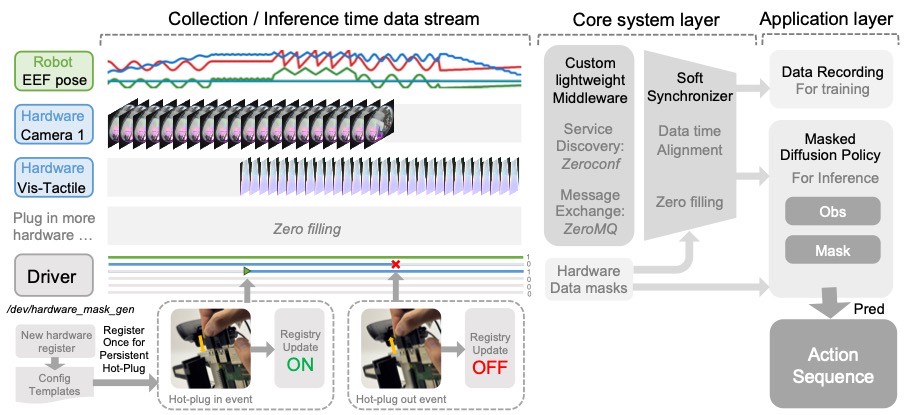
The driver-level Physical Mask abstraction derives modality presence from USB hot-plug events. This enables auto-configuration and graceful degradation: policies can continue executing even when sensors are physically added or removed at runtime.
Developing robotic manipulation policies is iterative and hypothesis-driven: researchers test tactile sensing, gripper geometries, and sensor placements through real-world data collection and training. Yet even minor end-effector changes often require mechanical refitting and system re-integration, slowing iteration. We present RAPID, a full-stack reconfigurable platform designed to reduce this friction. RAPID is built around a tool-free, modular hardware architecture that unifies handheld data collection and robot deployment, and a matching software stack that maintains real-time awareness of the underlying hardware configuration through a driver-level Physical Mask derived from USB events. This modular hardware architecture reduces reconfiguration to seconds and makes systematic multi-modal ablation studies practical, allowing researchers to sweep diverse gripper and sensing configurations without repeated system bring-up. The Physical Mask exposes modality presence as an explicit runtime signal, enabling auto-configuration and graceful degradation under sensor hot-plug events, so policies can continue executing when sensors are physically added or removed. System-centric experiments show that RAPID reduces the setup time for multi-modal configurations by two orders of magnitude compared to traditional workflows and preserves policy execution under runtime sensor hot-unplug events.

Explore the RAPID hardware design in 3D. Use your mouse to rotate, zoom, and pan the model.
The driver-level Physical Mask abstraction derives modality presence from USB hot-plug events. This enables auto-configuration and graceful degradation: policies can continue executing even when sensors are physically added or removed at runtime.
The video below demonstrates that USB hot-plug events correctly trigger topic and mask changes in real-time as sensors are physically connected and disconnected.
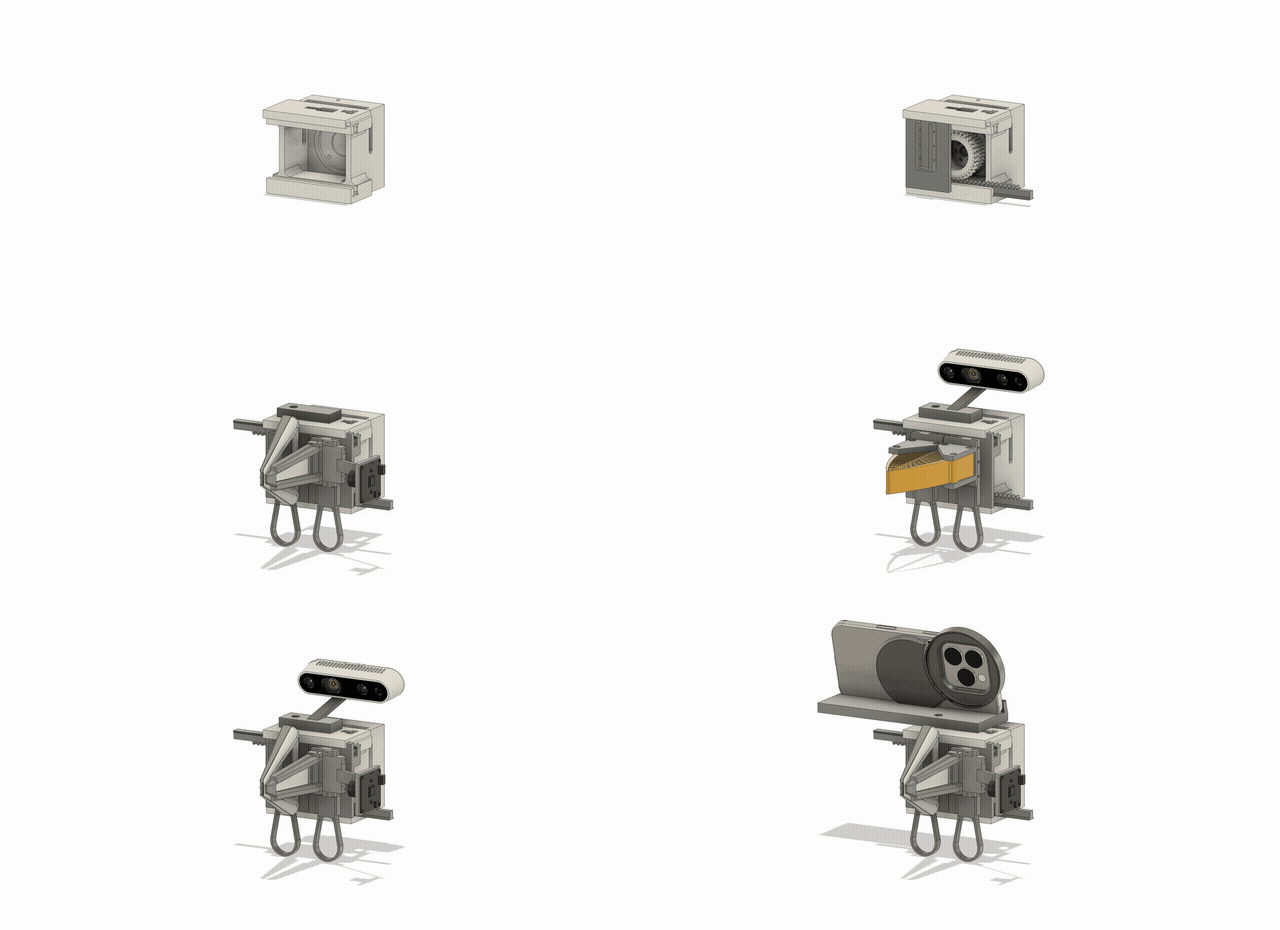
RAPID supports diverse multi-modal configurations including wrist cameras, tactile sensors, and motor state feedback. Use the slider to explore different configuration states.
RAPID's compact, lightweight, and wearable design allows the human hand to directly sense force and tactile feedback during data collection. This enables capturing perception-driven, fine-grained manipulation tasks—such as striking a match, handwriting, wrist flicking, or tossing small objects—that require subtle force control beyond traditional teleoperation.
@article{yin2026rapid,
title = {RAPID: Reconfigurable, Adaptive Platform for Iterative Design},
author = {Yin, Zi and Li, Fanhong and Zheng, Shurui and Liu, Jia},
journal = {arXiv preprint arXiv:2602.06653},
year = {2026},
}